
Why Winning More Work Can Push a Profitable Contractor Into a Cash Crisis
Profit lands at the end of a job. Cash gets consumed at the start of the next one. Growth widens that gap — and it's where good companies quietly run out of room.
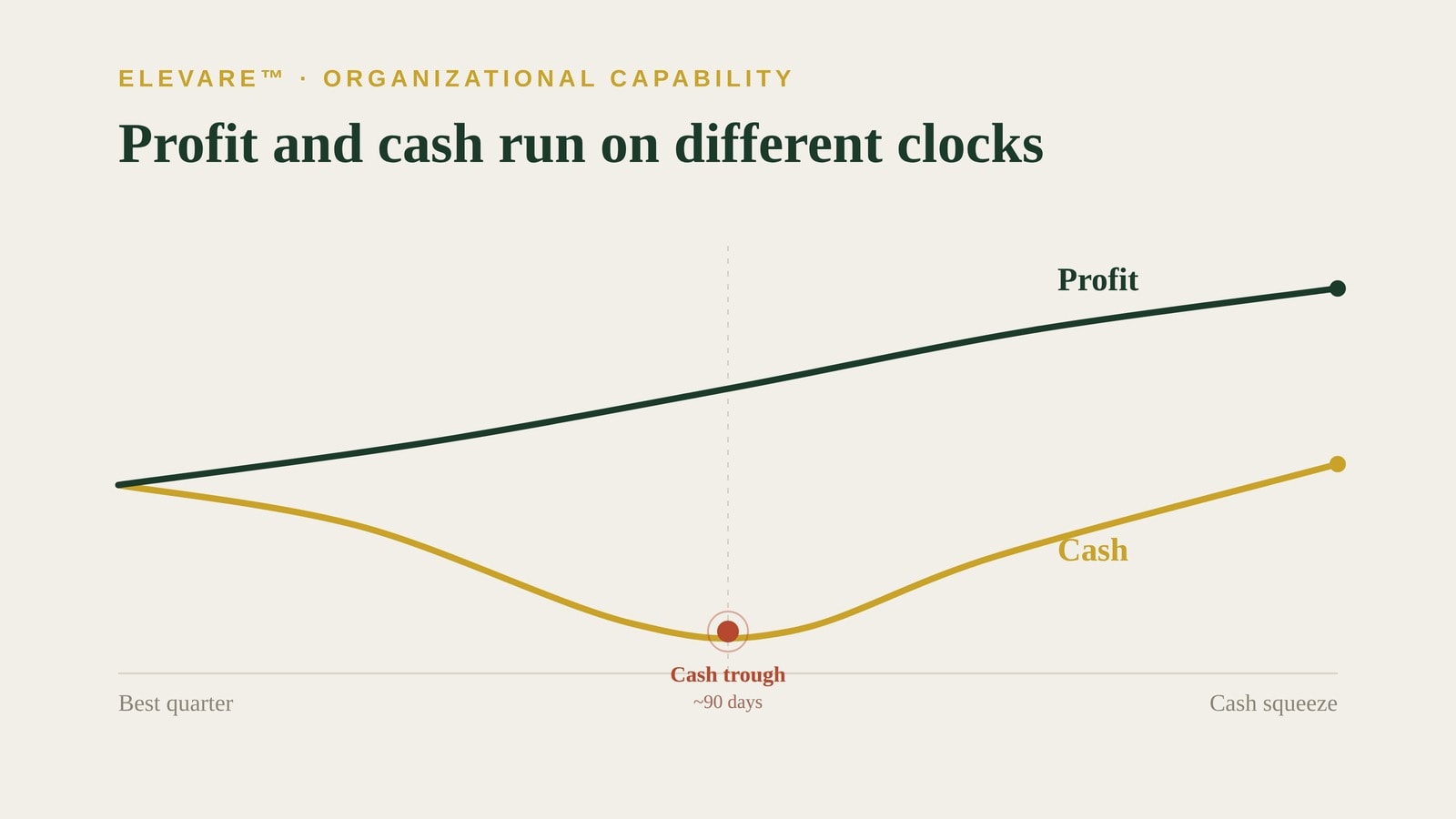
A contractor closes the strongest quarter in the company's history. Backlog is full. Margins look healthy. Three new jobs signed in six weeks, each one a clean, profitable award. The owner has every reason to feel that the business has finally turned a corner.
Six weeks later, that same owner is moving money between accounts on a Thursday night to make Friday's payroll.
Nothing went wrong. No job blew up. No client refused to pay. That's the part that makes it so disorienting — and so dangerous. The company didn't fail because it lost money. It got squeezed because it made money faster than it could collect it.
This is one of the most common ways a healthy construction company gets into trouble, and it almost never shows up on the P&L until it's already happening.
Profit and cash run on two different clocks
Profit is a report about the past. It tells you what a job earned once it closed. Cash is a live position — it tells you what you can actually spend today.
In most industries those two numbers drift a little. In construction they can point in completely opposite directions for months at a time, because of how the work is financed. You buy materials, mobilize crews, pay subs, and carry the job — often for weeks — before the first meaningful payment comes in. Retainage holds back a slice of every draw until the very end. On a job that will eventually book a healthy margin, you spend real money for a long time before you ever see it come back.
For a single job, you feel this and you plan around it. The problem is what happens when you run several of these curves at once, and start a new one before the last one has paid you back.
Why growth makes it worse, not better
Here's the trap. The faster you win and start new work, the more of these front-loaded cash curves you're carrying simultaneously — and the more of your own money is tied up in work that hasn't paid yet.
A slow-growing company finishes one job largely before the next one ramps. The cash from the first helps fund the second. A fast-growing company stacks the ramp-ups on top of each other. Every new award is a fresh demand on cash before it becomes a source of cash. So the better your quarter looks in the pipeline, the tighter your bank account gets in the next one.
That's the cruel logic of it: the reward for a great sales quarter is a cash squeeze. The owner reads "record backlog" as good news, and it is — but it's also a bill coming due.
Three forces usually widen the gap at exactly the moment things feel best:
Speed of new starts. Each mobilization is a cash outflow that lands weeks ahead of the matching inflow. Cluster your starts and you cluster the outflows.
Payment timing and retainage. Draws lag the work. Retainage sits on the sidelines until closeout. On paper the margin is earned; in the bank, a real chunk of it is frozen until the job is fully done.
Quiet margin fade. The margin you bid is rarely the margin you finish with. Small change-order leakage, a sub that underperforms, a stretch of weather — none of it is a catastrophe, but it thins the cushion right when you're leaning on it hardest.
None of these are failures. They're the normal physics of the business. What turns them into a crisis is not seeing them coming.
The number that would have warned them
Ask most contractors how much cash they'll have in the bank ninety days from now and you'll get a shrug, or a gut feel, or "we should be fine." The honest answer is usually that they don't know — because they're tracking profit, which reports the past, instead of forecasting cash, which describes the future.
A cash forecast is not the same thing as a P&L or a WIP schedule. It's a forward-looking map of when money actually leaves and when it actually arrives — draw by draw, payroll by payroll, sub payment by sub payment — projected out far enough to see the squeeze before you're standing in it.
The owner in the story didn't need a better bookkeeper. Every number was already sitting in the accounting system. What was missing was anyone turning those numbers into a picture of the next ninety days. A serviceable forecast would have shown the trough weeks in advance — early enough to stage the new starts, negotiate a draw schedule, lean on a line of credit on the company's terms instead of in a panic, or simply hold one award back two weeks. Cheap moves, if you make them early. Expensive or impossible if you make them the night before payroll.
Forecasting cash is a capability, not a spreadsheet
It's tempting to treat this as a template problem — build the forecast once, and you're covered. It isn't. The value isn't in the file. It's in whether the company can reliably see its own near future and act on it.
That's worth measuring on its own. Not just do we have a forecast, but how close does the forecast come to what actually happens? A company whose 90-day cash projection is consistently off by a wide margin doesn't really have a forecast — it has a wish. A company whose projection lands close, month after month, has built something far more valuable than any single number: it has bought itself time to make decisions instead of reactions.
That's the distinction that separates a company that grows on its own strength from one that grows itself into a corner. Both can be profitable. Both can have a record backlog. Only one of them can tell you, on any given Thursday, whether next month is safe.
The reframe
A great quarter is not proof that the company is healthy. It's a stress test the company is about to run on itself. Profit tells you the work was worth doing. Cash tells you whether you'll still be standing when the reward finally arrives.
If you can't say — with reasonable confidence — where your cash will be ninety days from now, then your next strong quarter isn't just good news. It's a question you haven't answered yet.
Answer it before the backlog answers it for you.

Renato Lerner
Founder, Elevare™
Renato Lerner has 30 years of experience in construction in Brazil, Angola, and the United States. He is the founder of Elevare™ and creator of the Organizational Capability Diagnostic.