How to Know If Your Construction Company Is Ready to Scale
Backlog tells you there is demand. Margin tells you the work can be profitable. Neither tells you whether your organization can absorb what comes next.
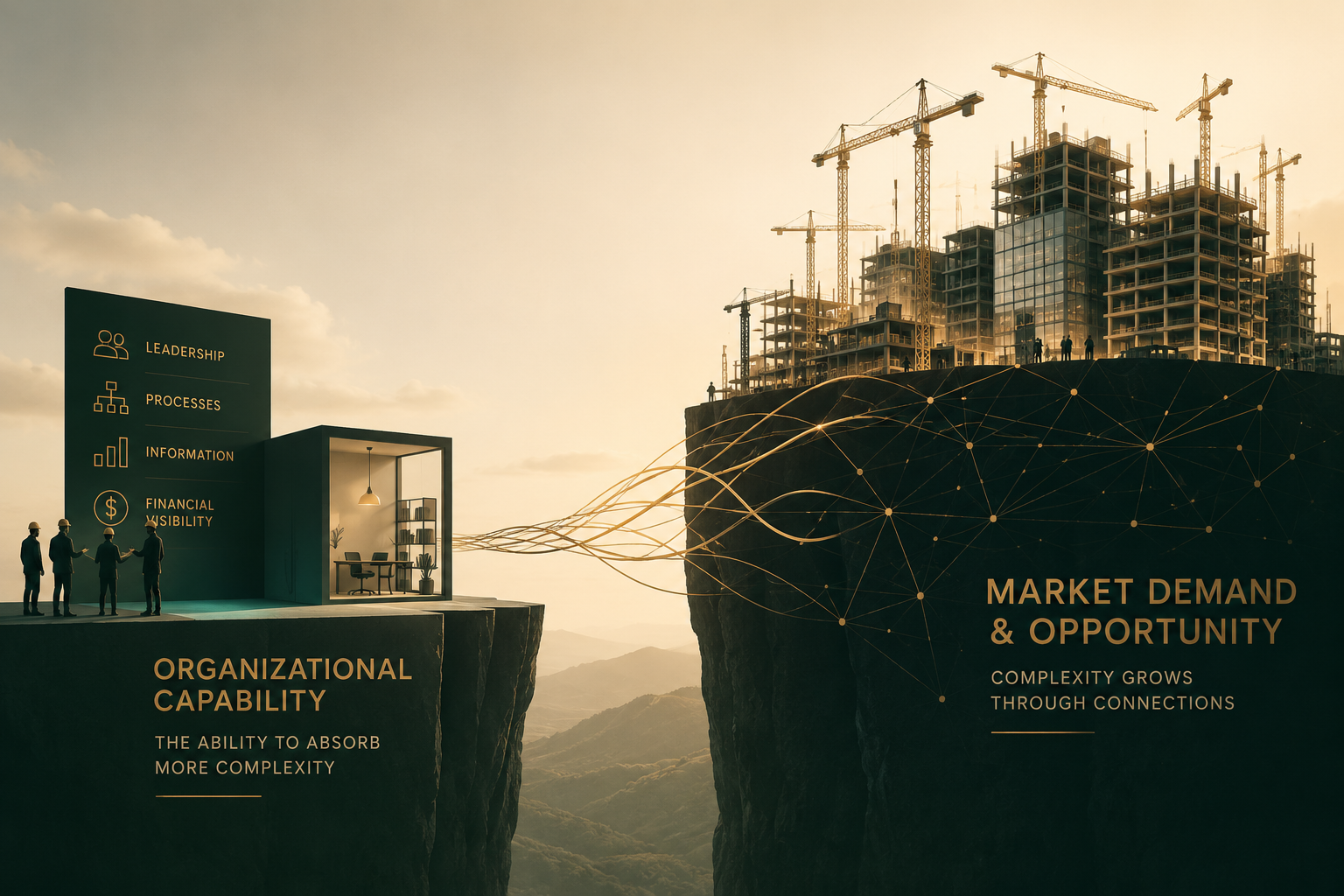
A construction company can have everything it was working toward — a strong backlog, healthy margins, good clients, more opportunities than it can pursue — and still not be ready to grow.
That sounds contradictory because we tend to treat growth as a commercial question.
Can we win more work?
But that is only half the question.
The harder one is:
Can the organization absorb more work without degrading what already works?
Those are not the same thing.
I have seen companies with plenty of demand that should not have taken the next project. Not because the project was bad. Not because they lacked bonding capacity or financing. And not because they were poorly managed.
They simply had less organizational room than their backlog suggested.
The next project did not create the weakness. It exposed it.
Growth doesn't just add work. It adds connections.
When a contractor goes from five projects to six, it is tempting to think workload increased by twenty percent.
Organizations don't work that way.
The sixth project adds another superintendent, another client relationship, another billing cycle, another set of subcontractors, another schedule, another stream of RFIs, another set of decisions competing for attention.
And every one of those things interacts with what is already there.
Complexity grows through connections.
That is why a company can handle $30 million comfortably and struggle at $40 million even though it has the people, equipment and financing that, on paper, should be enough.
The constraint is often not a resource.
It is the organization's ability to coordinate those resources.
The wrong question is "Do we have capacity?"
Most companies answer the capacity question by counting things.
Do we have enough project managers?
Enough superintendents?
Enough working capital?
Enough bonding?
Enough equipment?
Those are necessary questions. But they measure available resources, not organizational capability.
A company can have another PM available and still have every meaningful decision returning to the owner.
It can have cash and still be unable to forecast the cash demand created by three simultaneous mobilizations.
It can hire another superintendent and still have information from the field arriving too late to prevent a problem.
So before taking on more work, I would look for something different.
I would look for room.
Here are six places to find it.
1. Decisions can move without you
This is the first test because it exposes the structure faster than almost anything else.
Imagine adding a project tomorrow.
Who gets the additional decisions?
If the answer is ultimately you, the company has not really added management capacity. It has added another source of demand on the same decision-maker.
That works for a while because experienced owners are extraordinarily good at carrying complexity personally.
They answer faster. They remember more. They know the clients, the subs, the history and the exceptions.
But personal capacity does not scale.
Before growing, ask:
What decisions will this new project create, and who can make them without escalating them to me?
If you cannot name the person and the decision criteria, that capacity probably does not exist yet.
2. Problems reach decision-makers while they are still small
A healthy organization does not eliminate problems.
It discovers them early.
That distinction matters.
Construction will always produce surprises: design conflicts, subcontractor failures, procurement delays, field conditions, owner changes.
The question is not whether they happen. It is how long they remain inside the organization before reaching someone who can act.
Growth increases distance.
There are more jobs, more people, more layers and more information competing for attention.
So look at the last three serious problems in the company and ask:
When did the first person know?
Then:
When did the person capable of making the necessary decision know?
The gap between those two moments tells you something about your ability to absorb more complexity.
If the gap is already widening, another project will rarely make it shorter.
3. Your forecasts are trustworthy enough to make commitments
Growth is a commitment about the future.
You commit labor that has not yet been used, cash that has not yet been spent, management attention that has not yet been demanded and schedule capacity that has not yet been tested.
That means your ability to grow safely depends heavily on your ability to forecast.
Not perfectly.
Reliably.
Look at the last several projects.
How close was estimated cost to final cost?
How stable was cost-to-complete as the job progressed?
How close were cash projections to actual cash?
How often did schedules move materially after the project began?
Every company misses forecasts. What matters is whether the misses are random or systematic.
If estimates consistently become less favorable as reality arrives, the organization is not just forecasting badly.
It is overestimating its future capacity.
And that becomes dangerous when the same forecasts are being used to decide whether to accept more work.
4. The next project doesn't require your best people to be in two places at once
This is one of the simplest tests I know.
Take the next meaningful opportunity and build the team on paper.
Not job titles. Names.
Who is the PM?
Who is the superintendent?
Who owns estimating during handoff?
Who manages procurement?
Who handles the client?
Who reviews financial performance?
Then look at where those same people are today.
If the growth plan works only because your strongest people will somehow stretch across several critical responsibilities simultaneously, you do not have capacity.
You have optimism.
The same applies to the owner.
A surprising number of growth plans depend on the founder continuing to do everything they currently do while also absorbing the exceptions created by the new work.
That is not a structure. It is a temporary subsidy from one person's time.
5. Cash can absorb the growth curve, not just the project
A profitable project can still consume cash for months before returning it.
That becomes more important as growth accelerates because new projects tend to consume cash at the same time.
Mobilization.
Payroll.
Materials.
Subcontractors.
Retainage.
Billing delays.
The relevant question is therefore not:
Is this project profitable?
It is:
What happens to company cash when this project is added to every project already underway?
A company ready to scale should be able to model that answer with reasonable confidence.
If the answer depends on collections arriving exactly when expected, margins holding exactly as bid and no meaningful surprise occurring, the company is not operating with room.
It is operating on precision.
And construction rarely rewards plans that require precision.
6. One bad month doesn't force the whole organization into exception mode
This may be the most important test.
Every company has bad months.
A key employee leaves.
A client pays late.
A project slips.
A subcontractor fails.
A large change order becomes disputed.
The question is what happens next.
Does the organization absorb the event and continue operating?
Or does everything change?
Does the owner get pulled back into operations?
Do meetings multiply?
Do decisions slow down?
Do people get moved between jobs?
Does the cash plan collapse?
Do other projects begin suffering because one project has a problem?
That difference is organizational slack.
A company ready to grow does not need to be free of problems.
It needs enough room that one problem does not become everybody's problem.
Capacity is not the same as readiness
This distinction is worth making.
You may have the capacity to take another project and still not be ready to scale.
Capacity is what you can carry today.
Readiness is whether the systems, leadership, information and financial visibility will continue working after complexity increases.
That is why adding people immediately before growth does not necessarily solve the problem.
A new PM is not management depth on the day they arrive.
A new process is not organizational capability because it exists in a manual.
A new dashboard is not visibility until leaders trust it enough to make decisions from it.
Capability takes time to become real.
And growth has a habit of testing it before it is ready.
The question I would ask before signing the next large job
Not:
Can we execute this project?
Most good contractors can find a way to execute almost anything.
I would ask:
What will become weaker in the company if we take it?
If the answer is cash, leadership attention, decision speed, field visibility, estimating capacity, project controls or management depth, you have identified the real cost of the opportunity.
Sometimes that cost is acceptable.
Sometimes you can build the missing capability before the project starts.
Sometimes you can stage the start, change the team, negotiate terms or wait.
And sometimes the right decision is still to take the project — but to do it knowing exactly what the organization is about to consume.
That is very different from discovering the constraint halfway through the job.
Growth should consume opportunity, not the company
The goal is not to build an organization with unlimited spare capacity.
That would be expensive and unnecessary.
The goal is to know how much room exists between the complexity the company is carrying and the capability available to carry it.
I call that room the Buffer™.
When the Buffer is healthy, growth consumes part of it and the organization remains stable.
When it is thin, even a good project can push the company into exception mode.
When it is gone, growth starts consuming the organization itself — leadership attention, cash resilience, decision quality, people and eventually margin.
That is why backlog alone cannot tell you whether you are ready to scale.
Neither can revenue.
Neither can margin.
Those numbers tell you whether the market is giving you an opportunity.
Your organizational capability tells you whether you can safely take it.
Before you ask how much more work you can win, find out how much more complexity your company can carry.

Renato Lerner
Founder, Elevare™
Renato Lerner has 30 years of experience in construction in Brazil, Angola, and the United States. He is the founder of Elevare™ and creator of the Organizational Capability Diagnostic.